
Ottoman Land Deed Translation: Tapu Senedi and Hüccet
An Ottoman land deed, called a tapu senedi (title deed certificate), is the document issued to a person who held rights over a plot of land, a house, a vineyard, or a shop. Families in many former Ottoman lands, including the Balkans, Cyprus, the Levant, and Anatolia, still keep these papers. Langora reads the deed you have, transliterates it into Latin script, and translates it into English or another language you need.
Two other document types are often confused with the tapu senedi:
- Hüccet (court deed): a document issued by a kadı (Islamic court judge) recording a legal act, such as the sale of privately owned property. Before the reforms of the mid-nineteenth century, many property transactions were documented in this form.
- Tapu tahrir defterleri (land and tax survey registers): large registers compiled mainly in the fifteenth and sixteenth centuries to list villages, households, and expected tax revenue for a district. They are fiscal surveys. They do not record ownership of an individual plot, and they are held in state archives, not in family papers.
The modern form of the tapu senedi belongs to the period after the Ottoman Land Code of 1858 and the title deed regulations that followed it. Deeds from this period are usually printed forms completed by hand.
What the document contains
The exact layout changed over time and by region. A typical nineteenth-century deed records the following:
| Ottoman script | Transliteration | English meaning |
|---|---|---|
| طاپو سندی | tapu senedi | title deed certificate |
| حدود | hudud | boundaries of the plot, usually given by the four directions and the neighboring owners |
| دونم | dönüm | unit of land area |
| تصرف | tasarruf | right of possession and use |
| فراغ | ferağ | transfer of rights, for example by sale |
| انتقال | intikal | transfer by inheritance |
| اراضی میریه | arazi-i miriye | state-owned land held under usufruct |
| ملك | mülk | freehold property |
| بدل | bedel | price or value paid |
Most deeds also give the province, district, and village or town quarter; the type of property; the name of the holder with the father's name; the date; a register or serial number; and the fees paid.
Why it is hard to read
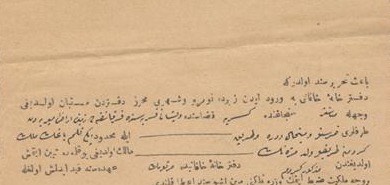
- Script. Handwritten entries are usually in Riq'a, the everyday cursive of nineteenth-century administration. Older court deeds may use more formal or more compressed hands.
- Formulaic language. Deeds combine Ottoman Turkish with Arabic legal terms. The meaning of a term such as tasarruf depends on the category of land, so a literal translation can mislead.
- Dates. A deed may be dated in the Hijri (Islamic lunar) calendar, the Rumi (also called Mali, or fiscal) solar calendar, or both. The two systems give different year numbers for the same day.
- Numbers and measures. Areas, prices, and fees can be written in words, in Arabic-script numerals, or in abbreviated form. Units of measure are local and historical.
- Condition. Folded paper, faded ink, and stamps placed over the text are common.
What you receive
- A transliteration of the full text in Latin script
- A translation into English or the language you request
- Explanatory notes on legal terms, land categories, units, and place names
- Conversion of every date to the Gregorian calendar
- Delivery as DOCX or PDF; TEI-XML on request
Every translation is checked by a second specialist before delivery, as part of an internal process based on ISO 17100 standards and principles.
Please note: Langora does not provide sworn or certified translations. If a court, land registry, notary, or other public authority requires a sworn translation, Langora is not the right provider for that use. Our translations are intended for research, family records, and personal understanding.
How pricing works
- Printed and clearly legible texts: translation starts from €0.18 per source word, transliteration from €0.12 per source word.
- Handwritten documents, which includes most deeds, are quoted after we see a sample. You receive a fixed total before any work begins.
- A fixed project coordination fee applies to each order.
- If you need help obtaining a document from an archive, research time is charged at an hourly rate.
The delivery time is stated in the quote, after we have seen the document.
How to send it
Email a clear photograph or scan of every page, front and back, to [email protected]. Tell us what you need (transliteration, translation, or both), the target language, and how you plan to use the document. For sensitive material, we can agree on a suitable transfer method first.
Frequently asked questions
Can you tell me who owns the land today?
No. We translate what the deed says. Current ownership is a matter for the land registry and legal advisers in the country concerned.
My deed is from Cyprus, Palestine, or Greece. Can you read it?
Yes, if it was issued under Ottoman administration and written in Ottoman Turkish. Send a sample and we will confirm.
Can you find other deeds or ancestors connected to this land?
Langora reads and translates the documents you already have. We do not carry out family history or genealogical searches in archives.
Is a hüccet the same as a tapu senedi?
No. A hüccet is issued by a court and records a legal act. A tapu senedi is issued by the land administration and certifies the right to hold a property.
Will the translation be accepted by a court?
Our translations are not sworn or certified. If you need a translation for official proceedings, please consult a sworn translator recognized in that jurisdiction.
Related pages
Have a project?
Whether it is a single document or a large-scale archival project, we are ready to help.
Request a quote